Thesis: museum work has been trivialized by the appropriation of the word "curate." It's a contributing factor to why people think my degrees are worthless and volunteers can do what I have been trained to do.
 |
| Curate: the chocolate bar |
I suppose that, inherently, the problem is that "curate" is kind of tricky to define....or maybe just museum types like problematizing definitions? I think it is a rather slippery term that varies widely in usage, with particularly unclear areas of overlap with collections managers, for instance. I was just reading through some materials on AAM's website, particularly the
Curators Committee (CurCom), just to see if maybe it was just fuzzy in MY mind, and it sounds like nope: if you read the
Code of Ethics for Curators (AAM, 2007), you find a lot of tasks that, in my experience, fall to folks with the title "collections manager" or, dare I say it, "archivist/librarian." Which is hardly shocking, as the document itself notes. The
Curator Core Competencies (AAM, undated, post-2014) maybe narrow it down even better: curators are defined by competency, not job title, and they have responsibilities in collections management, research, and education/outreach. (:sigh/want:)
In my experience, they are a little lighter on the collections management end--usually those tasks, beyond the planning and accession/deaccession review phase, fall to the collections manager and/or registrar. So that means that most curators, from what I've seen, focus primarily on the research, planning, education, and outreach components of the job. This is particularly interesting in cultural anthropology and archaeology collections, these days, as much more work is done collaboratively with source communities. This is totally appropriate, as anthropology has had it's postcolonial come-to-Jesus moment and realized that some of its practices were not reflective of what they had learned about other people and ways of being (cue cultural relativism and self-determination), or even morally consistent with just being a good and compassionate person.
I think it's worth noting that curation in an anthropology/archaeology context is a little different than in other disciplines: while it's fine and good to have expert academic knowledge of a subject, that is generally not the most important thing. Better to be able to serve as a liaison with people who have an (for want of a better term) authentic or lived expert knowledge of said subject--or, of course, to have that lived knowledge yourself, which I put last in this list because that is a state of being that is not really acquired as a competency for vocational reasons. In anthropology, it seems that the "[academic] subject matter expert" is on the way out, and with, well, reasonable reason. It's part of the democratization of the representation of people's lived heritage and the "companionable objects," to use
Kenneth George's term, that correspond with that lived experience.
But I digress: curatorship. If we discount most of the day-to-day collections work, as done primarily handled by collections managers and registrars (and, not gonna lie, interns and temp workers), and recognize that, in anthropology, at least, the subject-matter expert piece is waning and the community liaison piece waxing, what do curators do?
The answer seems to be mostly education and outreach. That can, again, go back to the cultural liaison piece, but also has a lot to do with programming, exhibits, advocacy, and so forth. And that's interesting because it's probably about the last thing we think of when we think of curatorship.
So I guess we can see why "curate" has been picked up in popular culture, as meaning "making a list of things I like," or really, "choosing." But that is madly frustrating because curatorship is not just making lists of things I like. No,
Etsy members, you are not curators, because you lack any of the competencies of curatorship. Moreover, your notion of curatorship doesn't involve knowing a body of literature or any information outside your own self and your own preferences. It can--maybe some of these folks do make a study of historic textiles or what have you, but at heart, it's "what I like," reflecting more of the self than of any external idea, or maybe at best, "things I found [and like] that all have this one thing in common [have a picture of a penguin on them, include a feather, whatever]." I don't mean to sound terrible: I love me some Etsy! I have lists of THINGS I LIKE, but I do not consider them "curated lists." They're wishlists, guys. Come on.
And the reason that this really gets my goat is because, in professional positions that were, in effect, curatorial (although the title was archivst), I got pressure all the time to let other, non-trained folks do the collections work because, since it's just about choosing stuff you like, anyone can do it! Not so. And that is why, when I go to the grocery and see a rack of faux-healthy candy bars named "Curate," I start banging my head on my shopping basket.
Of course, all this goes out the window if, as one of my friends suggested, they don't mean curate-the-verb, they mean
curate-a-church-official.
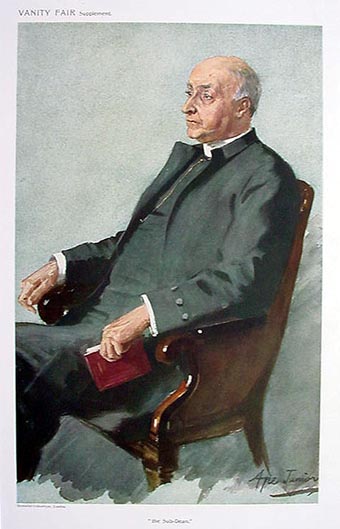 |
| Edgar Sheppard, Curate at Marlow and Hornsey and a canon of St George's Windsor |


